
Choosing between a water softener, a whole-house filter, and reverse osmosis in Albuquerque starts with one question: what problem are you trying to fix? Each system targets something different, and buying the wrong one is the most common and costly mistake. This guide shows what each does, what they cost, and which combination fits.
The Short Answer: What Each One Does
| Your problem | Best fit |
|---|---|
| Scale, spots, dry skin, crusty fixtures | Water softener |
| Chlorine taste, sediment, odor in the whole house | Whole-house filter |
| Lead, nitrate, arsenic, or dissolved solids in drinking water | Reverse osmosis (RO) |
| Iron or sulfur on a private well | Well-water filter, after testing |
These are not interchangeable. A filter does not remove hardness, and a softener does not make water taste better or remove contaminants. NSF, the group that sets voluntary treatment standards, says certification does not mean a system reduces every possible contaminant. ABCWUA says the same: no one unit removes everything.
Water Softener: Fixes Scale, Not Taste
The Albuquerque Bernalillo County Water Utility Authority (ABCWUA) says its water runs from moderately hard to hard, depending on the source blend and your distribution zone. Hardness is calcium and magnesium, and heating water drops them out as scale.
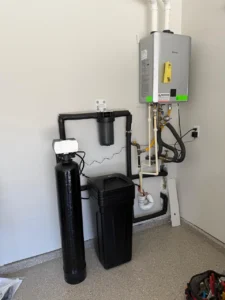
A salt-based softener removes those minerals by ion exchange. That protects your water heater, fixtures, and appliances, and it makes soap lather better. ABCWUA notes that white flecks in fixtures can be scale from the heater, and that many manufacturers recommend periodic flushing. See our water softener installation page for what a typical job includes.
One trade-off: a salt-based unit adds a small amount of sodium. If someone in your home is on a sodium-restricted diet, an RO tap at the kitchen sink is a common fix. Ask your doctor.
Whole-House Filter: Taste, Sediment, and Chlorine
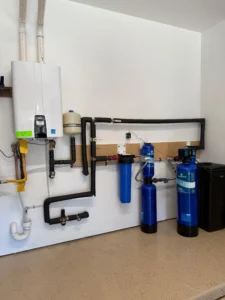
A whole-house filter treats water where the main line enters your home. HomeAdvisor says it can remove contaminants like chlorine, sulfur, and iron. Carbon and sediment stages handle taste, odor, and particles. They do not remove hardness minerals.
Certification matters here. NSF/ANSI 42 covers aesthetic effects such as taste and odor. NSF/ANSI 53 covers health effects such as lead. Ask which one a product holds, and for which contaminants.
Our water softeners and filtration page covers whole-house options.
Not Sure Which System You Need?
Get upfront pricing before any work starts. Same-day appointments available.
Reverse Osmosis: Drinking Water at One Tap
Reverse osmosis pushes water through a fine membrane, usually with carbon filters on either side. NSF/ANSI 58 is the standard for RO systems. Most guides say RO removes the widest range of contaminants of any common home system, including lead, arsenic, nitrate, and dissolved salts.
It has trade-offs. RO sends some water down the drain as concentrate, and it strips minerals along with contaminants, which can leave water tasting flat. Most homes use it at one kitchen tap for drinking and cooking, not the whole house. If your only goal is better taste, a carbon filter is simpler. Learn more on our reverse osmosis page.
What Albuquerque Water Actually Needs
ABCWUA says the water it supplies meets or beats all federal and state drinking water standards, and that it tests for more than 180 substances. So for most city homes, treatment is about scale, taste, and personal preference, not a safety fix.
A few local points change the advice:
- Hardness. ABCWUA publishes data by distribution zone. In USGS terms, moderately hard to hard is roughly 61 to 180 mg/L, and ABCWUA says to divide ppm by 17.1 to get grains per gallon.
- Lead. ABCWUA says lead usually comes from corrosion of home plumbing, such as pipes, faucets, and solder, not the supply. It will test your tap for lead at no cost. If you have older plumbing, ask for that test before spending on RO.
- Dissolved solids. ABCWUA notes that dissolved minerals leave residue on evaporative coolers each summer. RO reduces dissolved solids at your drinking tap, while a softener does not.
- Private wells. ABCWUA’s data does not cover wells. If you are in the East Mountains on a well, test it first. ABCWUA points well owners to the New Mexico Environment Department, and a certified lab can test for a fee.
- Rotten egg smell. ABCWUA says this is often bacteria in a sink drain, and sometimes the water heater, not a water supply problem. No filter fixes it.
What Each One Costs
These are national ranges from cost guides. They vary by home and conflict across sources, and quotes are free.
| System | Typical installed cost | Ongoing cost |
|---|---|---|
| Salt-based softener | About $1,000 to $3,000 | Salt and upkeep |
| Whole-house filter | About $1,000 to $4,000 | About $50 to $300 per year |
| Under-sink RO | About $300 to $950 | Filter and membrane changes |
| Whole-house RO | About $4,800 to $8,000 | Higher |
Whole-house RO is rarely needed. New Mexico charges gross receipts tax instead of sales tax, and it can appear on invoices, so ask whether your quote includes it.
Which Combination Fits Your Home
- Scale and spots, city water: a softener alone is often enough.
- Scale plus drinking-water concerns: softener plus an under-sink RO at the kitchen tap.
- Taste and chlorine bother you, but hardness does not: a whole-house carbon filter.
- Lead found in a tap test: RO or an NSF 53 filter at that tap, plus a look at the old plumbing.
- Private well: test first, then size treatment to the results.
A cheaper route can be right. If your hardness is moderate, regular flushing from our water heater maintenance and flushing service may be enough for now.
Mistakes to Avoid and What to Ask Your Plumber
Common mistakes:
- Buying a filter to fix hard water, or a softener to fix taste.
- Installing RO for the whole house when one tap would do.
- Skipping the lead test or a well test.
- Blaming the water for a drain smell. A cleaning from our drain cleaning service can fix that.
- Comparing quotes that include different equipment.
Ask your plumber:
- What problem is each part of this quote solving?
- What is my hardness, and what was it based on?
- Which NSF certifications does the equipment hold?
- Does the quote include drain connections, permits if needed, and gross receipts tax?
- What are the yearly filter, membrane, and salt costs?
We serve homes across the metro. See our service areas.
Frequently Asked Questions
Do I need a softener, a filter, or RO in Albuquerque?
It depends on your problem. Softeners fix scale, filters fix taste and sediment, and RO cleans drinking water at one tap. Many homes need only one or two.
Does a whole-house filter soften water?
No. Carbon and sediment filters do not remove calcium and magnesium. You need a softener for hardness.
Is Albuquerque tap water safe to drink?
ABCWUA says its water meets or beats all federal and state standards. Treatment is often about taste and scale. Lead can come from older home plumbing, and ABCWUA offers free lead testing.
Does reverse osmosis waste water?
Yes. RO sends some water down the drain as concentrate. It also removes minerals, which can make water taste flat.
Can I use a softener and RO together?
Yes, and it is a common pairing. The softener protects the home from scale, and RO cleans the kitchen drinking tap.
Softener, Filter, or RO? Get a Straight Answer
Locally owned and licensed in New Mexico, with free quotes and upfront pricing before work starts.