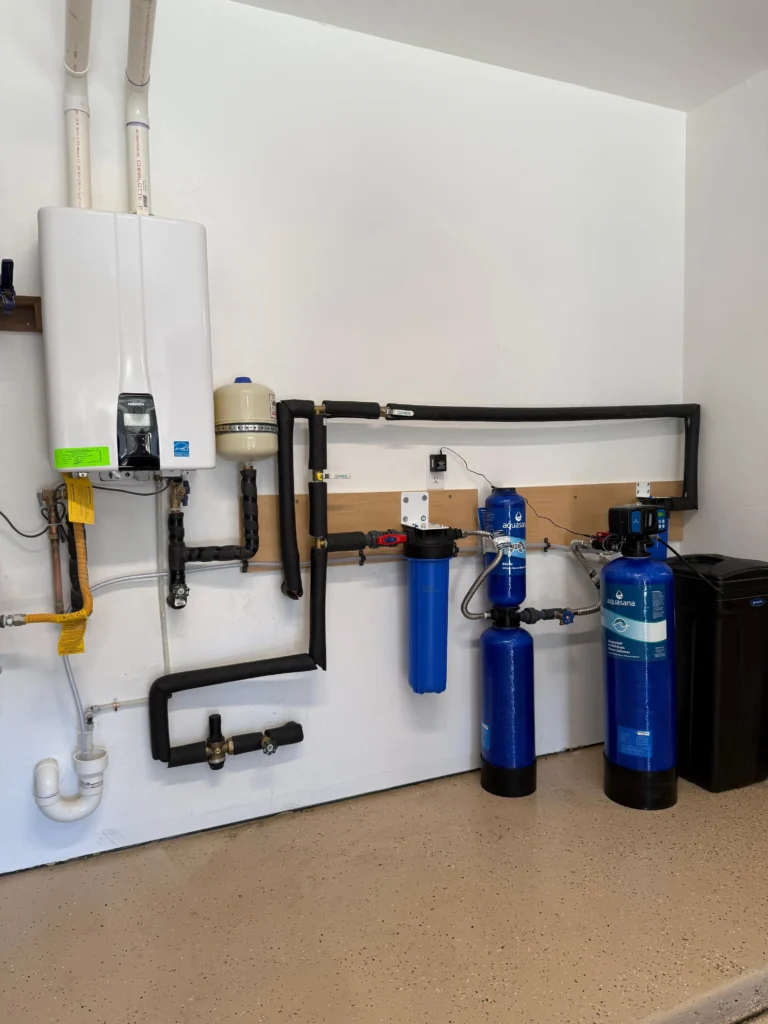
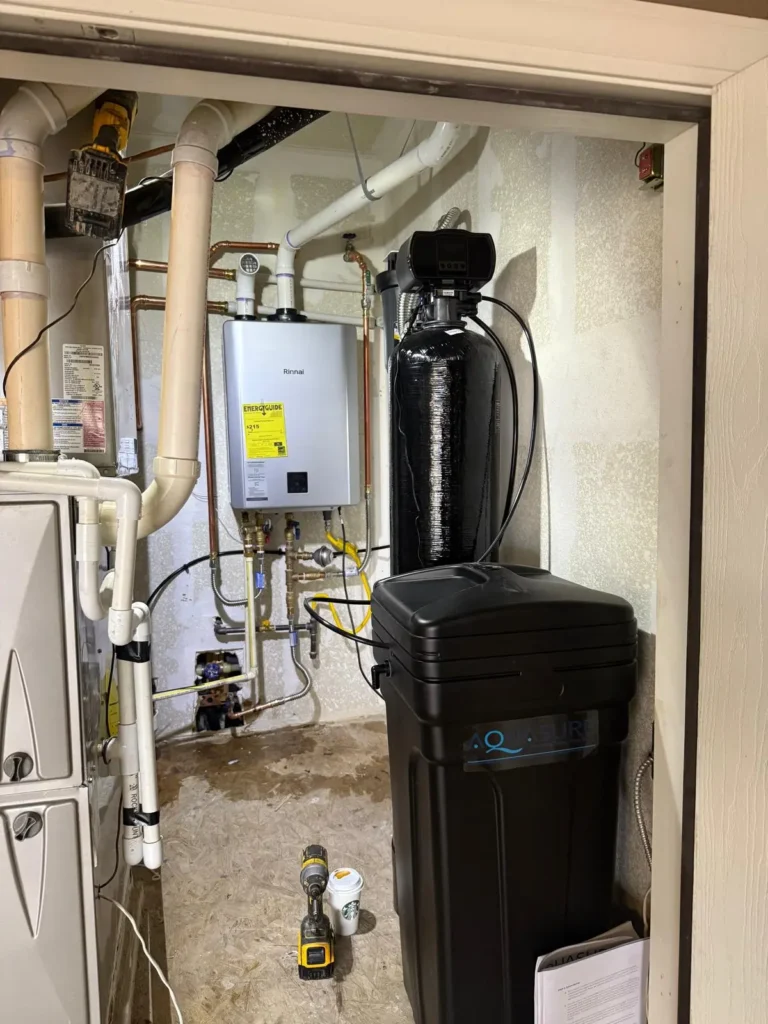
Choosing between tankless vs tank water heater options in Albuquerque is not only about price. Hard water, gas line size, and our elevation change the answer. This guide covers what matters here so you can decide before the old heater fails.
Tankless vs Tank Water Heater: Quick Comparison
| Tank | Tankless | |
|---|---|---|
| Typical installed cost | About $600 to $2,500 | About $1,400 to $3,900 |
| Typical lifespan | 8 to 12 years | 15 to 20 years |
| Hot water supply | A set amount, then recovery time | Continuous, up to the unit’s flow limit |
| Space | Floor space in a closet or garage | Wall mounted |
| Upkeep in hard water | Annual flush | Descaling at least once a year |
| Gas line and venting | Usually reuses what you have | Often needs a larger gas line and new venting |
A tank stores hot water and keeps it warm all day. A tankless unit heats water only when a tap opens. That is why tankless never runs out, but it can only heat so many gallons per minute at once. Two showers and a dishwasher can push a small unit past its limit.
What Each Type Costs
NerdWallet lists typical installed costs of about $600 to $2,500 for a tank and $1,400 to $3,900 for tankless. Labor alone runs about $150 to $450 for a tank and $600 to $1,900 for tankless. Gas tankless jobs can land above that range when venting or gas piping needs work.
Switching from tank to tankless is where quotes climb. You may need a new gas line, new venting, a wall mount, and sometimes an electrical outlet. Prices vary by home, and quotes are free, so get the scope in writing.
New Mexico charges gross receipts tax instead of sales tax, and it can show up on invoices. Ask whether your quote includes it.
Not Sure Which Water Heater Fits Your Home?
Get upfront pricing before any work starts. Same-day and emergency appointments available.
Hard Water: The Biggest Local Factor
The Albuquerque Bernalillo County Water Utility Authority (ABCWUA) says its water ranges from moderately hard to hard, depending on the source blend and your distribution zone. You can look up your zone on the ABCWUA website. Hardness means calcium and magnesium, and heating water leaves them behind as scale.
ABCWUA also notes that white flecks clogging fixtures can be scale from your water heater, and that many manufacturers recommend periodic flushing. Tanks collect scale at the bottom. Our water heater maintenance and flushing service clears it before it hardens.
Tankless units push water through a small heat exchanger, so scale hits them harder. Navien recommends descaling at least once a year and says the right schedule depends on mineral content, temperature setting, and use. Its method circulates cleaning solution for at least 45 minutes, then flushes. Navien suggests a professional do it, since mistakes can put your warranty at risk.
A water softener protects either type, plus your fixtures and appliances. If you are on private well water in the East Mountains, test the water first, because ABCWUA’s numbers do not apply to wells.
Gas Lines, Venting, and Altitude
This is where tankless retrofits get expensive. Rheem’s gas line guidance says most tankless units use about 140,000 to 200,000 BTU or more, making them one of the largest appliances on a home’s gas system. A typical tank is about 40,000 BTU. Many tankless units call for a 3/4-inch gas line, and your meter and regulator may need a check.
Older homes in the North Valley, Nob Hill, Old Town, and Downtown often have gas piping sized for the appliances of their day. If you plan to switch, our gas line replacement and upgrade work can be part of the quote.
Altitude matters too. Albuquerque sits at roughly 5,300 feet, and parts of Sandia Heights and the East Mountains are higher. Rinnai’s technical bulletins show altitude-specific settings for its units, and some models have shorter maximum vent lengths above 5,000 feet. Always ask your installer how they set up the unit for our elevation.
Winter adds one more factor. Colder incoming water means a tankless unit heats less water per minute, so it must be sized for the coldest months, not July.
Rebates and Permits
New Mexico Gas Company (NMGC) expanded its efficiency program in July 2026. Its water heating page lists rebates of up to $500 on qualifying gas water heaters, storage or tankless. The rules say:
- You must be an NMGC residential gas customer.
- The equipment must be new.
- A participating contractor must install it.
- Some models must be ENERGY STAR certified.
NMGC says rebates arrive in 6 to 8 weeks. NMGC also says a qualifying heater can cut energy use by up to 30% and save as much as $50 a year on gas bills. That means the case for tankless rests more on lifespan, space, and endless hot water than on the utility bill.
Permits matter as well. The City of Albuquerque says installing a water heater requires a plumbing/mechanical permit, and the work can only be done by a licensed contractor. Our water heater replacement work is handled by a New Mexico licensed team.
Which One Fits Your Home
A tank is usually the better fit if:
- Your current heater meets your needs and you are replacing on a budget.
- You want to keep your existing gas line and venting.
- You may move within a few years.
Tankless is usually the better fit if:
- You run out of hot water with a full house or a big soaking tub.
- You want floor space back.
- You plan to stay long enough for the longer lifespan to pay off.
- You are willing to descale yearly and treat the water.
Tank heaters also carry a leak and flood risk as they age, and tankless units do not. For an overview of every option, see our water heater services page.
Mistakes to Avoid and What to Ask Your Plumber
Common mistakes:
- Sizing by square footage instead of peak hot water use.
- Choosing tankless without checking the gas line and meter.
- Skipping descaling and risking the warranty.
- Skipping the permit.
- Buying before checking whether the model qualifies for the NMGC rebate.
Ask your plumber:
- Is my gas line big enough, and what will it cost to change?
- How is the unit set up for Albuquerque’s altitude?
- Does the quote include venting, permit, removal of the old unit, and gross receipts tax?
- Are you an NMGC participating contractor, and will you file the rebate?
- How is the unit protected from freezing if it sits in an unheated garage or on an outside wall?
- Should I add a water softener?
We serve homes across the metro. See our full list of service areas, or ask for a tankless water heater installation quote.
Frequently Asked Questions
Is a tankless water heater worth it in Albuquerque?
It can be, if your gas line, venting, and water quality are handled. It costs more up front, so the payoff comes from lifespan, space savings, and endless hot water. Hard water means yearly descaling is part of the deal.
Do tankless water heaters work at Albuquerque’s altitude?
Yes, but they need the right settings. Manufacturers such as Rinnai publish altitude instructions, and some models limit vent length above 5,000 feet. Ask your installer how they handle it.
Can I swap my tank for a tankless without changing the gas line?
Sometimes, but often not. Many gas tankless units need a 3/4-inch line, and your meter may need review. A plumber should check this before you buy.
How long do tank and tankless water heaters last?
Most sources list 8 to 12 years for a tank and 15 to 20 years for tankless. Flushing, descaling, and softening the water help either type last longer.
Do I need a permit to replace my water heater?
Yes. The City of Albuquerque requires a plumbing/mechanical permit, and a licensed contractor must do the work. Ask your plumber to include the permit in the quote.
Tankless vs Tank Water Heater? Get a Straight Answer
Locally owned and licensed in New Mexico, with 24/7 emergency availability across Albuquerque.