When a water softener stops working, you usually notice spots on glasses, stiff laundry, and scale on faucets again. The cause is often simple, and a few fixes take minutes. This guide covers six common problems, how to test whether your softener is working, and what changes in Albuquerque.
Do These 4 Checks First
- Check the bypass valve. It sits at the back of the control head. If it is open, hard water flows around the resin tank. Set it to the service position in your manual.
- Check the power. Confirm the plug is in, the outlet works, and the display is on. After an outage, check that the clock and settings are right.
- Check the salt. Look in the brine tank. Add salt if it is low.
- Check the hardness setting. It should match your water test, not a default.
If none of these fix it, move on.
6 Common Water Softener Problems
1. The Bypass Valve Is Open or the Unit Has No Power
One dealer calls an open bypass valve the single most common cause of “my softener stopped working” calls. A partially open valve lets raw hard water mix with softened water. A tripped breaker or unplugged unit stops regeneration entirely.
2. The Brine Tank Is Out of Salt
No salt means no regeneration, and the resin cannot recharge. Add salt to the level your manual shows, not to the top. If the salt level never drops over several weeks, one troubleshooting guide says the system may not be drawing brine properly.
3. A Salt Bridge or Salt Mush
A salt bridge is a hard crust that forms above the water line, so salt looks full but sits unused underneath. Mush is dissolved salt that recrystallizes into sludge at the bottom. Both block regeneration.
Culligan says to consult your owner’s guide before breaking a bridge, and to schedule professional service if it is hard to reach or keeps returning. Many guides suggest gently breaking a bridge with a broom handle, then running a manual regeneration. Do not pound or stab the tank. Mush usually means emptying, cleaning, and refilling.
4. Wrong Settings or Timer
If the hardness setting is too low, or the regeneration schedule does not match your water use, you can run out of soft water between cycles. An incorrect timer can also waste salt. Check the settings against your manual and your actual hardness test.
5. A Clogged Injector, Brine Line, or Drain Line
The injector, brine line, and drain line must stay clear for regeneration. A kinked or blocked drain line can leave you with hard water after a cycle. If the brine looks clear after regeneration, the injector or brine line may be clogged. These are pro jobs, because they involve the control valve.
6. Worn-Out or Fouled Resin
Resin beads lose their ability to exchange minerals over time. Some guides say resin can wear out after 8 to 10 years, and iron or sediment can foul it sooner. If hard water returns right after regeneration, worn resin or a failing control valve is a likely cause.
For help beyond basic checks, see our water softener repair page.
How to Test Whether Your Softener Is Working
Do not guess. Test the water.
- Use a hardness test strip or drop kit on a cold tap after a regeneration cycle.
- Compare it to your untreated water, taken before the softener.
- Convert ppm to grains per gallon by dividing by 17.1, as the Albuquerque Bernalillo County Water Utility Authority (ABCWUA) advises.
- Aim for the soft range. USGS classes soft water as 0 to 60 mg/L, or about 0 to 3.5 grains per gallon.
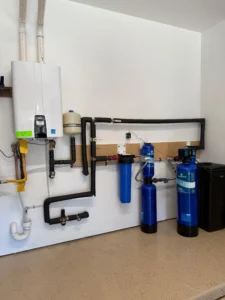
ABCWUA says its water runs from moderately hard to hard, depending on the source blend and your zone. If your treated water reads in that range, something is wrong. Our water softeners and filtration page covers options.
Softener Still Not Working? Call J&J Plumbing LLC
Get upfront pricing before any work starts. Same-day appointments available.
Albuquerque Factors That Change the Fix
- Hard water load. In a moderately hard to hard area, a softener works harder, so settings and salt levels matter more.
- Well water. ABCWUA’s numbers do not apply to private wells. If you are in the East Mountains, test the well. Iron on well water can foul resin, and one guide recommends resin cleaner for that.
- Power interruptions. After an outage, controllers can lose their clock and regeneration timing.
- Freezing. A softener in an unheated garage or outbuilding faces extra stress in winter. Ask how yours is protected.
- Scale on your heater. A failing softener lets scale build up. ABCWUA notes scale can show up as white flecks from the water heater, and many manufacturers recommend periodic flushing. Our water heater maintenance and flushing service clears it.
Repair or Replace?
Simple fixes like salt, settings, a clogged line, or a stuck valve are usually worth repairing. Worn resin or a failing control valve on an older unit may tip toward replacement. Many sources say salt-based softeners last 10 to 15 years with care.
For budgeting, national guides list installed salt-based softeners at about $1,000 to $3,000. Prices vary by home, and quotes are free. New Mexico charges gross receipts tax instead of sales tax, and it can appear on invoices, so ask whether your quote includes it. If replacement makes sense, see our water softener installation page.

Mistakes to Avoid and What to Ask Your Plumber
Common mistakes:
- Adding salt without checking for a bridge.
- Leaving the bypass valve open after service.
- Using sharp tools to break a salt bridge.
- Taking apart the control valve without the manual.
- Ignoring hard water signs for months.
Ask your plumber:
- What caused the problem, and can you show me?
- Is this a repair, or is the unit at the end of its life?
- What hardness setting do you recommend, and why?
- Does the quote include parts, labor, and gross receipts tax?
- Is my unit protected from freezing?
We serve homes across the metro. See our service areas.
Frequently Asked Questions
Why is my water still hard with a softener?
Common causes are an open bypass valve, no salt, a salt bridge, wrong settings, a clog, or worn resin. Test the water to confirm.
How do I know if my softener is regenerating?
Check that the salt level drops over a few weeks and that the control head cycles. If the brine looks clear and salt never drops, the system may not be drawing brine.
How do I fix a salt bridge?
Consult your owner’s guide, then gently break the crust with a broom handle and run a manual regeneration. If it keeps returning, call a pro.
How long does a water softener last?
Many sources list 10 to 15 years for salt-based units. Hard water and neglect can shorten that.
Can I fix a softener myself?
Salt, bypass, power, and settings are fine to check. Clogs, valves, and resin work are better left to a plumber.
Water Softener Not Working in Albuquerque? Call J&J Plumbing LLC
Locally owned and licensed in New Mexico, with free quotes and upfront pricing before work starts.