A rotten egg smell in your water has a few different causes, and where you smell it tells you which one. This guide walks through a simple hot versus cold test, what each result means, and what to do about it in an Albuquerque home.
First: Is It the Water or Gas?
Natural gas has no smell on its own. New Mexico Gas Company (NMGC) adds an odorant that gives it a rotten egg odor, so a leak can smell the same as a sulfur problem in your water.
Check where the smell is strongest. If it is in the air and not just at a faucet, leave the building and call NMGC at 1-888-664-2726 or 911 from outside. NMGC says continued exposure can dull your sense of smell, so do not assume a faint smell is nothing. A gas detector helps.
If the smell only appears when you run water, keep reading.
Hot vs Cold: A 5-Minute Test
- Run a cold tap for a minute and smell the water in a glass.
- Run a hot tap and smell it the same way.
- Check other faucets, since a single sink can be its own problem.
- Match your results to the table.
| What you smell | Likely source | What to do |
|---|---|---|
| Hot water only | Water heater | Flush the tank, check the anode rod |
| Hot and cold, whole house | Water source or well | Test the water |
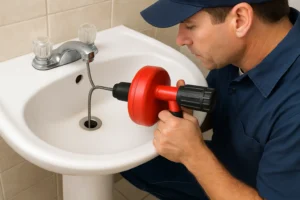
| One faucet only, hot and cold | The drain under that sink | Clean the drain and aerator |
| Smell in the air | Possible gas leak | Leave and call NMGC or 911 |
Hot Water Only: The Water Heater
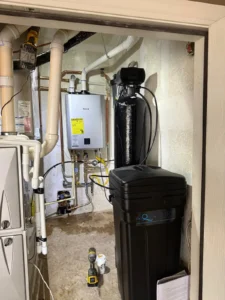
Plumbing and water treatment sources agree on the usual cause. Sulfate-reducing bacteria can live in warm tank water and turn natural sulfate into hydrogen sulfide gas. A magnesium anode rod inside the tank can feed that reaction. The result is a rotten egg smell from the hot tap and not the cold.
Other causes include a worn anode rod and sediment buildup, which gives bacteria a place to grow. Common fixes are:
- Flush the tank to remove sediment. Our water heater maintenance and flushing service does this.
- Replace or swap the anode rod. Some plumbers recommend a different rod material or a powered rod when the smell keeps returning.
- Sanitize the tank if bacteria are the cause. This is a job for a licensed plumber.
The Albuquerque Bernalillo County Water Utility Authority (ABCWUA) says its water runs from moderately hard to hard, depending on the source blend and your zone. That means scale can build up in tanks, and ABCWUA notes that many manufacturers recommend periodic flushing. See our water heater services or our water heater repair team for a diagnosis.
Hot Water Smells Like Rotten Eggs? Call J&J Plumbing LLC
Get upfront pricing before any work starts. Same-day appointments available.
Buttons: Call (505) 589-6934 | Get a Free Quote
One Faucet Only: Check the Drain
If only one sink or tub smells, and it smells in both hot and cold, the problem is probably that fixture’s drain. ABCWUA says a rotten egg smell is often bacteria in a sink drain, and sometimes the water heater, not the water supply.
A few steps to try:
- Remove and clean the drain stopper.
- Clean the faucet aerator.
- Run water down the drain for a minute and sniff the air near the opening.
If the smell stays, a clog or buildup in the line may be the cause. Our kitchen and bathroom drain cleaning service can clear it.
Hot and Cold: Well Water or the Water Source
If both hot and cold smell throughout the house, the source is the likely cause. In well water, hydrogen sulfide forms naturally from decaying matter and sulfur-reducing bacteria in groundwater.
If you are on a private well in the East Mountains, test it. The New Mexico Environment Department (NMED) says well owners are responsible for their own water and recommends annual tests for bacteria, nitrate, and arsenic. ABCWUA’s numbers do not apply to wells. A water test shows what is in your water so you can pick the right treatment.
If you are on city water and both taps smell, contact ABCWUA to report it. Many sources say a whole-house smell on city water is uncommon. Our water softeners and filtration page covers treatment options.
Is It Safe?
For most homes the smell is more of a nuisance than a health issue, but it deserves a look. Have a private well tested for bacteria, as NMED recommends, since a smell can mask other problems. If anyone is sick, or the smell is strong or sudden, get the water tested and call a professional.
Mistakes to Avoid and What to Ask Your Plumber
Common mistakes:
- Assuming a gas smell is just the water.
- Replacing the whole heater before checking the anode rod and flushing.
- Treating a well without testing it first.
- Ignoring a single smelly drain.
- Skipping the sniff test at several faucets.
Ask your plumber:
- Is the smell in hot water only, or both?
- When was the tank last flushed, and what is the anode rod’s condition?
- Would a different anode rod help?
- If it is well water, what should we test for first?
- Does the quote include gross receipts tax? New Mexico charges it instead of sales tax, and it can appear on invoices.
We serve homes across the metro. See our service areas.
Frequently Asked Questions
Why does only my hot water smell like rotten eggs?
It usually means bacteria in the tank are reacting with the anode rod to make hydrogen sulfide. Flushing the tank and checking the rod often helps.
Why do both my hot and cold water smell like rotten eggs?
The source is the likely cause. On a private well, hydrogen sulfide can occur naturally in groundwater, so test the water.
Could a rotten egg smell be a gas leak?
Yes. NMGC adds an odorant that smells like rotten eggs. If the smell is in the air, leave and call NMGC at 1-888-664-2726 or 911.
Why does only one faucet smell?
ABCWUA says bacteria in a sink drain is a common cause. Clean the stopper and aerator, and call a plumber if it persists.
Can I fix the smell myself?
You can clean drains and aerators. Water heater sanitizing, anode rod work, and well treatment are better left to a professional.
Water Smells Like Rotten Eggs in Albuquerque? Call J&J Plumbing LLC
Locally owned and licensed in New Mexico, with 24/7 emergency availability across Albuquerque.