Brown water from your tap can look scary, but it is often short-lived and easy to fix. The key is finding where the problem starts: the city water main, the pipe to your house, your indoor pipes, or your water heater. A few simple checks will point you in the right direction.
Start with one question: where does the color show up? Cold taps, hot taps, one faucet, or the whole house? This chart covers the most common answers.
| What you see | Most likely cause | What to do first |
|---|---|---|
| Brown cold water that clears in a few minutes | Sediment stirred up in the water main | Flush your cold taps (steps below) |
| Brown water that will not clear at the outside hose bib | A problem on the main or the line to your home | Call the Water Authority, then a plumber |
| Brown or yellow water from hot taps only | Water heater sediment, a worn anode rod, or iron bacteria | Hold off on hot water for laundry and get the heater checked |
| Cloudy water that clears in a glass | Trapped air | Nothing. It is harmless |
| Cloudy water with white specks | Mineral scale from hard water | Flush the water heater |
| Brown water only after the house sat unused | Rust in old steel pipe | Check pipe age and material |
If your neighbors see the same thing, the cause is probably in the street. If only your home has it, look at your own pipes and water heater.
Why Albuquerque Tap Water Turns Brown
According to the Albuquerque Bernalillo County Water Utility Authority (ABCWUA), brown or “dirty” water is usually caused by naturally occurring iron and manganese particles. These settle inside the water lines. They get stirred up when water speeds up because of construction, maintenance, or fire department use of hydrants.
The Water Authority says this kind of discoloration does not mean the water is unsafe to drink. It can stain laundry, though. So wait until the water runs clear before you wash light-colored clothes.
How to Flush Your Plumbing Step by Step
The Water Authority recommends a whole-house cold water flush. Here is how to do it.
- Use cold water only. Skip the hot taps so your water heater does not fill with dirty water.
- Start outside. Open the hose bib closest to the street and let it run for about five minutes.
- Check the color. If it clears, go inside and run every cold tap, from the front of the house to the back. Include tubs and showers.
- If it will not clear at the hose bib, the problem may be on the main line. Call Water Authority Dispatch at 505-842-WATR (9287), Option 1.
- Wait on laundry until the water runs clear.
If a flush does not solve it, the Water Authority may send its NO-DES truck. It connects two hydrants, scrubs the pipe between them, filters the water, and returns it to the system.
Here is a useful clue. If the hose bib runs clear but your indoor taps stay brown, the cause is likely inside your plumbing.
Brown Water Will Not Clear? Call J&J Plumbing LLC
Get upfront pricing before any work starts. Free quotes and same-day appointments available.
Cloudy Water: Air First, Scale Second
Most cloudy water is air. Water in the city system is under pressure, and air dissolves in it. When the water leaves the tap, the air bubbles out and makes it look milky. The Water Authority says this does not affect water quality. Fill a clear glass and set it down. If the cloud fades in a few minutes, it was air.
If the water stays cloudy or you see white specks, think scale. The Water Authority says Albuquerque water ranges from moderately hard to hard, depending on the blend of sources. Heating water makes dissolved minerals drop out as scale. ABCWUA says white particles that clog fixtures may be calcium carbonate from your water heater. A thermostat set too high can make it worse.
Flush the tank using the manufacturer’s directions. Our water heater maintenance and flushing service clears sediment before it hardens. For the long term, whole-house water treatment cuts down the scale that builds up in heaters and fixtures.
Brown Water Only From the Hot Tap
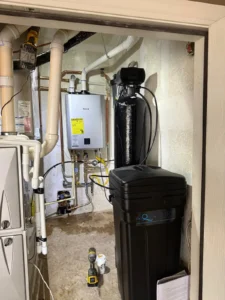
If cold water is clear and hot water is brown, start with the water heater. The cause is not always a rusted-out tank, though. A. O. Smith, a major water heater maker, says tank lining failures are rare. It says the most common cause of rusty hot water is iron bacteria. These bacteria are not toxic. They feed on iron and manganese in the water.
The company says conditions that make them more likely include softened water, well water, and long stretches with no water movement. It also says affected heaters often need a new anode rod. That is the metal rod inside the tank that corrodes so the tank does not.
A flush and a new anode rod may be all you need. If the tank is leaking or rusting at the base, replacement makes more sense. Our water heater repair team can diagnose it first and tell you which side of that line you are on.
Old Pipes and Water Lines in Older Homes
Galvanized steel pipe was widely used in homes for decades, mostly before about 1960. Some was installed later. It typically lasts about 40 to 60 years before rust builds up inside. Older homes, including some in the North Valley, Old Town, Downtown, and Nob Hill, may still have some of it.
Signs of failing steel pipe:
- Brown water at first use, then clearer
- Weak water pressure
- Rust spots at pipe joints
You can check the pipe type yourself. A magnet sticks to steel pipe but not to copper or plastic.
The pipe from your meter to your house is another common trouble spot. In many places, the owner is responsible for that stretch. Ask the Water Authority where its side ends. Our water line repair service covers problems on your side. If you also see a drop in pressure or an odd jump in your water bill, ask about leak detection. Replacing worn-out pipe is the lasting fix. Cleaning rust out of it rarely is.
East Mountains and Well Water
If you are on a private well, there is no city utility to call. Some East Mountains homes are in this group. The New Mexico Environment Department (NMED) does not regulate private wells, so testing is up to you.
NMED recommends yearly testing. The New Mexico Department of Health says to test every year for bacteria, nitrate, pH, and conductivity. It also says to test when you notice a change in color, taste, or smell.
NMED announced in August 2026 that well owners can bring samples to its field offices for free screening of nitrate, iron, and fluoride. Iron screening helps explain brown or orange water. For other tests, use a lab certified by NMED.
Should You Test Your Water?
Testing beats guessing. A water test shows what is actually in your water, so you fix the right problem.
City customers have a free option too. The Water Authority says it will test your water for lead at no cost. Call 505-842-WATR (9287), Option 1 to schedule a sample collection. It is worth doing if you have older plumbing and want peace of mind.
Mistakes to Avoid and What to Ask Your Plumber
Mistakes to avoid
- Running hot water while the cold side is still brown
- Doing laundry before the water runs clear
- Skipping the hose bib flush and calling for a repair first
- Draining the water heater without following the manufacturer’s directions
- Ignoring brown water that keeps coming back
What to ask your plumber
- Is the problem in the main, the line to my house, my indoor pipes, or my water heater?
- What material are my pipes, and how old are they?
- Does the anode rod need to be replaced?
- Should I test the water before we choose a fix?
- Will the quote be upfront, in writing, before work starts?
Frequently Asked Questions
Is brown tap water safe to drink in Albuquerque?
The Water Authority says discoloration from iron and manganese does not mean the water is unsafe. Still, let it run clear before you drink it. If it will not clear, call the Water Authority or a plumber.
How long does brown water last?
Often a few minutes of flushing clears it. If the water will not clear at the outside hose bib, the problem may be on the main line, so call the Water Authority.
Why is my water cloudy and then clear?
That is usually trapped air from the pressurized lines. Let a glass sit and the cloud rises out. It does not harm water quality.
Why is only my hot water brown?
The water heater is the first place to look. Sediment, a worn anode rod, or iron bacteria are common causes. A flush or a new anode rod often fixes it.
Who should I call, the Water Authority or a plumber?
Call the Water Authority if the water will not clear at the hose bib or if neighbors have it too. Call a plumber if the problem is in your hot water, one fixture, or your own pipes.
Brown Water in Albuquerque? Let J&J Plumbing Find the Cause
Locally owned and licensed in New Mexico, with free quotes and upfront pricing before work starts.