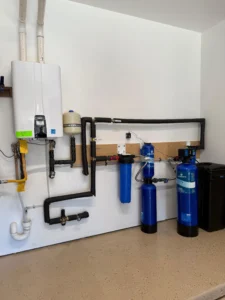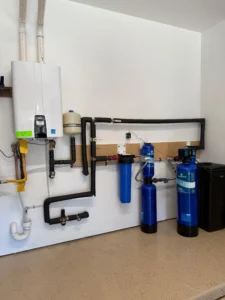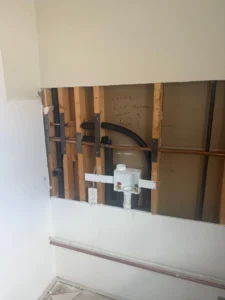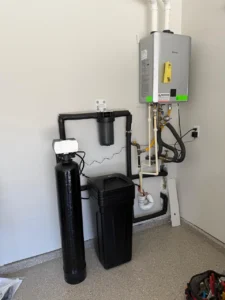
The salt vs salt-free water softener choice in Albuquerque comes down to what you want the system to do. One removes the minerals. The other changes how they behave. This guide explains the difference in plain terms, how it plays out in our water, and what to ask before you buy.
Salt vs Salt-Free: The Short Answer
| Salt-based softener | Salt-free conditioner | |
|---|---|---|
| Removes hardness minerals | Yes | No |
| Hardness test after install | Drops to near zero | Reads the same |
| Water spots and soap lather | Better | Little change |
| Needs salt | Yes | No |
| Needs a drain and power | Yes | Usually no |
| Typical installed cost | About $1,000 to $3,000 | About $2,100 to $3,600 |
Cost ranges come from national guides, vary by home, and are only a baseline. Quotes are free.
How Each One Works
A salt-based softener uses ion exchange. Resin beads hold sodium, and as hard water passes through, calcium and magnesium stick to the resin while sodium goes into the water. Every so often the unit flushes the resin with salty brine and sends the minerals down the drain.
A salt-free system is better called a conditioner. Most use template assisted crystallization, which turns dissolved minerals into tiny crystals that stay suspended instead of sticking to surfaces as scale. Nothing is removed, so a hardness test reads the same before and after. USGS notes that homeowners in hard-water areas usually use softeners that swap in sodium.
Because there is no simple at-home test for conditioner performance, results vary by system and water. Ask for proof and a clear return policy.
What Works in Albuquerque’s Water
The Albuquerque Bernalillo County Water Utility Authority (ABCWUA) says its water runs from moderately hard to hard, depending on the source blend and your zone. In USGS terms, that covers roughly 61 to 180 mg/L, or about 3.5 to 10.5 grains per gallon. ABCWUA says to divide ppm by 17.1 to get grains per gallon.
Some dealers say salt-free conditioners work best below about 10 grains per gallon. That is the upper end of ABCWUA’s range, so the choice depends on where your zone lands. If you want soft-feeling water, spot-free glass, and better lather, salt-based is the safer pick. If you mainly want to slow scale in the heater and pipes, a conditioner can make sense.
Wells are different. If you are on a private well in the East Mountains, test it first. ABCWUA’s numbers do not apply, and the New Mexico Environment Department says well owners are responsible for their own water. Very hard or mineral-heavy well water is usually a job for salt-based softening, so get a real number before you choose.
Not Sure Which Type Fits Your Home?
Get upfront pricing before any work starts. Same-day appointments available.
Water Heaters, Tankless Units, and Scale
Heating water drops minerals out as scale. ABCWUA notes that white flecks in fixtures can be scale from your water heater, and many manufacturers recommend periodic flushing. A. O. Smith says hard water speeds up corrosion and sediment buildup inside tank heaters.
Tankless units feel it most. Navien recommends descaling at least once a year. A salt-based softener cuts the load, while a conditioner may slow scale without lowering hardness. If a heater has already failed from buildup, our water heater replacement service can swap it, and treating the water protects the new one.
Check your heater’s warranty before choosing. Some manufacturers set water quality requirements, so ask whether a conditioner or a softener satisfies yours. Our water heater maintenance and flushing service still helps either way.
Cost and Upkeep
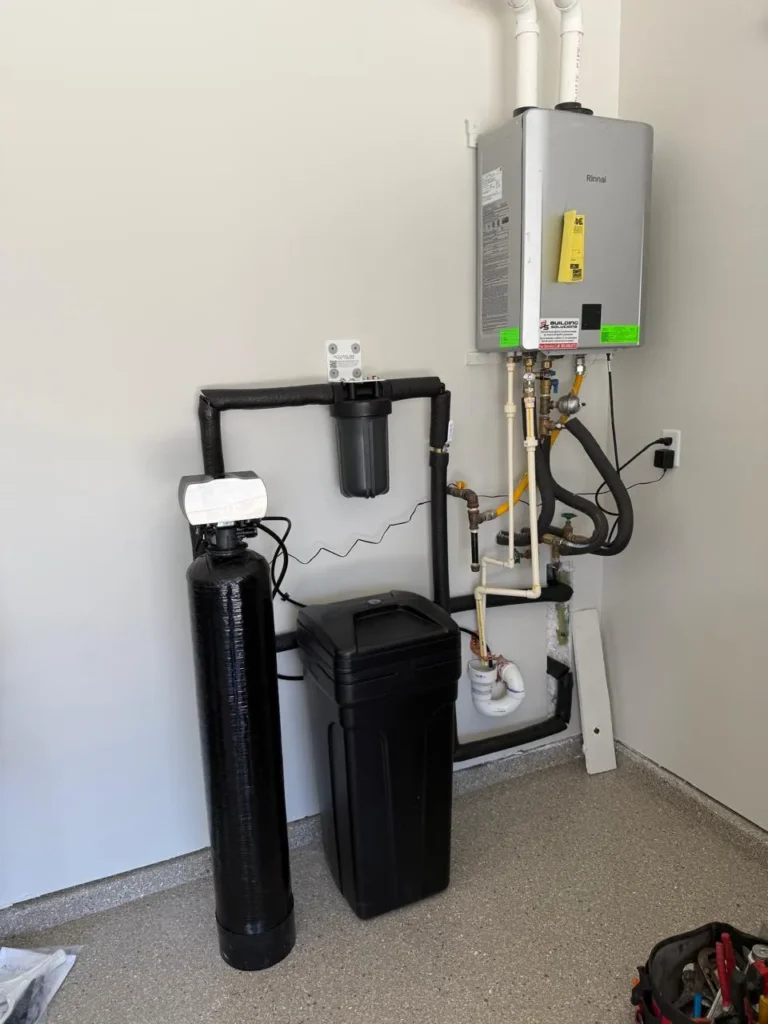
Salt-based units cost less up front and have regular running costs: salt, a bit of power, and water for regeneration. They also need a drain line and an outlet. Salt-free units cost more up front in many guides, but skip salt, drain, and wastewater. Some list media replacement every few years.
Sodium is a trade-off with salt-based units. Industry sources say about 30 mg of sodium is added per gallon for each grain of hardness removed. That is small for most people, but ask your doctor if you are on a sodium-restricted diet. A separate drinking tap or reverse osmosis can help.
Our water softener installation page covers what a typical job includes. New Mexico charges gross receipts tax instead of sales tax, and it can appear on invoices, so ask whether your quote includes it.
Which Should You Choose?
Pick salt-based if:
- You want truly soft water, better lather, and fewer spots.
- Your hardness is on the high side or you are on hard well water.
- You have a drain and outlet near the install spot.
Pick salt-free if:
- Your main goal is less scale in the heater and pipes.
- You want no salt, no drain, and less upkeep.
- You accept that water will still test hard.
Pick neither yet if you have not tested your water. A cheaper route, such as regular flushing, may be enough when hardness is moderate.
Mistakes to Avoid and What to Ask Your Plumber
Common mistakes:
- Buying a “salt-free softener” and expecting soft water.
- Choosing without testing your actual hardness.
- Skipping the sodium conversation with a doctor.
- Ignoring the heater warranty.
- Comparing quotes that include different things.
Ask your plumber:
- What is my hardness, and what do you recommend for it?
- How will you size the system?
- Does the price include install, bypass valve, drain, and removal of any old unit?
- What are the yearly costs for salt or media?
- Is gross receipts tax included?
See our water softeners and filtration options and service areas.
Frequently Asked Questions
Is a salt-free water softener really a softener?
No. It is a conditioner that reduces scale but does not remove hardness minerals. A hardness test reads the same before and after.
Which works better in Albuquerque?
It depends on your zone’s hardness and goals. Salt-based gives true soft water, while salt-free is a lower-maintenance scale control. Test your water first.
Is salt-free cheaper?
Not always. National guides list salt-free installs at about $2,100 to $3,600, often above salt-based units at about $1,000 to $3,000. Salt-free skips salt costs, though.
Do salt-based softeners add sodium?
Yes, a small amount. Industry sources estimate about 30 mg per gallon per grain of hardness removed. Ask your doctor if you are on a restricted diet.
Can I use either on well water?
Test the well first. Hardness and minerals vary, and heavy mineral content usually points to salt-based softening.
Salt vs Salt-Free Water Softener? Get a Straight Answer
Locally owned and licensed in New Mexico, with free quotes and upfront pricing before work starts.