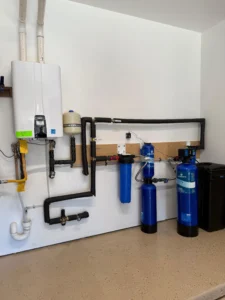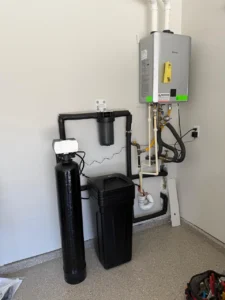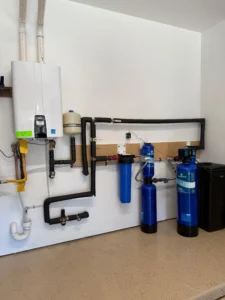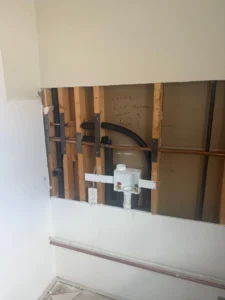
Whether you need a water softener in Albuquerque depends on your hardness, your scale problems, and how long you will stay in your home. Our water is safe to drink, but minerals build up inside heaters, fixtures, and appliances. This guide shows how to tell if softening is worth it for you and when it is not.
How Hard Is Albuquerque Water?
The Albuquerque Bernalillo County Water Utility Authority (ABCWUA) says treated surface water and groundwater are blended across the system. Depending on the sources and blend, hardness ranges from moderately hard to hard. That means your number depends on your distribution zone and can shift over time.
The U.S. Geological Survey (USGS) groups hardness into bands. The EPA has not set a legal limit for hardness, because the minerals are not toxic.
| Class | mg/L as calcium carbonate | Grains per gallon |
|---|---|---|
| Soft | 0 to 60 | 0 to 3.5 |
| Moderately hard | 61 to 120 | 3.5 to 7 |
| Hard | 121 to 180 | 7 to 10.5 |
| Very hard | Over 180 | Over 10.5 |
ABCWUA says to divide a ppm figure by 17.1 to get grains per gallon. In USGS terms, “moderately hard to hard” covers roughly 61 to 180 mg/L. Your zone’s water quality report will show a closer number for your address.
Signs You Need a Water Softener
If several of these sound familiar, hard water is likely costing you money:
- White crust on faucets, showerheads, and glass shower doors.
- Spots on dishes and glasses, even after the dishwasher.
- Soap that does not lather well and leaves a film.
- Dry-feeling skin or stiff laundry.
- Popping or rumbling from a tank water heater.
- Low flow from showerheads or aerators that keep clogging.
- A tankless heater that needs frequent descaling or throws errors.
USGS notes that hard water needs more soap and detergent and causes scaling in equipment. Scale also hides inside pipes and heaters, so you may not see the damage until something fails.
When You May Not Need One
A softener is not right for everyone. You may be fine without one if:
- Your zone’s hardness is on the moderate end and you see little scale.
- You rent or plan to move soon, and the upfront cost will not pay back.
- Someone in your home is on a strict low-sodium diet (see below).
- A regular flush of your water heater keeps up with the scale.
A cheaper option can be the right call. Our water heater maintenance and flushing service clears sediment before it hardens, and ABCWUA notes that many manufacturers recommend periodic flushing.
Not Sure If You Need a Softener?
Get a free quote and upfront pricing before any work starts. Same-day appointments available.
What a Softener Protects
Hard water leaves scale every time it is heated. ABCWUA says white flecks in your fixtures can be scale from the water heater. A. O. Smith says hard water speeds up corrosion and sediment buildup in tank heaters, which can shorten their life.
Tankless units are more sensitive. Navien recommends descaling at least once a year, and doing it wrong can put the warranty at risk. If you are considering a tankless water heater installation, price a softener at the same time.
A softener also helps faucets, showerheads, dishwashers, and washing machines. I have not claimed a dollar savings here, because it depends on your hardness and your equipment.
Sodium and Salt: The Trade-Offs
A salt-based softener swaps calcium and magnesium for sodium. USGS notes that many homeowners in hard-water areas use softeners this way. Industry sources say it adds roughly 30 mg of sodium per gallon for each grain of hardness removed. At 7 to 10 grains, that works out to about 13 to 19 mg in an 8-ounce glass.
That is small for most people, but it matters if a doctor has put you on a sodium-restricted diet. Ask your doctor first. A separate drinking-water tap or a reverse osmosis system can help in those homes. Keep in mind that salt-free conditioners reduce scale without removing the minerals, so they work differently.
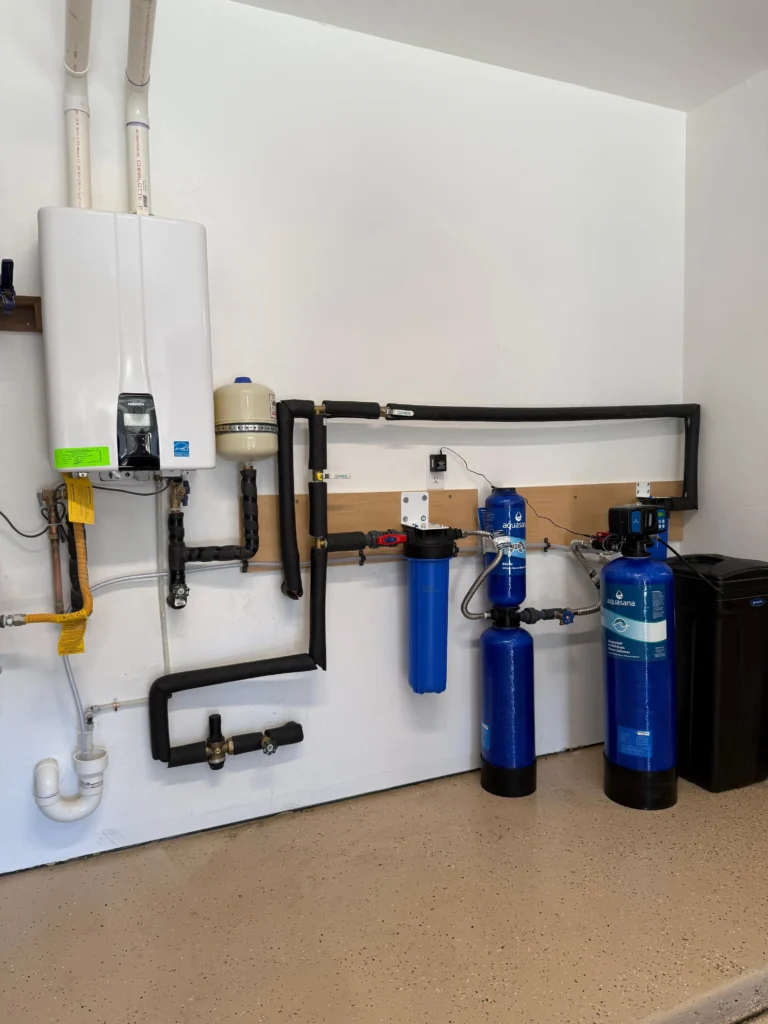
Also plan for running costs. Salt-based units use salt and a drain for regeneration, and they need upkeep. Our water softener installation page covers what a typical job involves.

How to Test Your Water
Do this before you buy anything.
- Look up your zone. Check ABCWUA’s annual water quality report for your area.
- Convert the number. Divide ppm by 17.1 to get grains per gallon.
- Check for scale. Look at your showerhead, kettle, and water heater drain water.
- Get a real test. A water test gives you a number for your home, not a regional estimate.
- Size it right. Sizing multiplies people, about 75 gallons per person per day, and hardness in grains per gallon.
If you are on a private well in the East Mountains, test it. ABCWUA’s data does not cover wells. The New Mexico Environment Department says well owners are responsible for their own water and recommends annual tests for bacteria, nitrate, and arsenic, plus uranium every five years. It also holds free “water fairs” around the state each year. Hardness is a separate test, worth adding if you see scale or poor lather.
Salt-Based or Salt-Free?
If hardness is your problem, a salt-based unit removes it. If you mainly want to slow scale and avoid salt, a conditioner can reduce buildup, though it does not make water soft. Our water softeners and filtration page covers options. Cost depends on size, type, and plumbing, and prices vary, so quotes are free.
Mistakes to Avoid and What to Ask Your Plumber
Common mistakes:
- Buying a softener without testing your actual hardness.
- Sizing by guess instead of household size and hardness.
- Skipping a drain and outlet check.
- Ignoring sodium if someone is on a restricted diet.
- Expecting a salt-free conditioner to give soft water.
Ask your plumber:
- What is my hardness, and how did you measure it?
- What size do you recommend, and why?
- Salt-based or salt-free for my situation?
- What will salt and upkeep cost each year?
- Does the quote include gross receipts tax? New Mexico charges it instead of sales tax, and it can appear on invoices.
We serve homes across the metro. See our service areas.
Frequently Asked Questions
Is Albuquerque water hard?
ABCWUA says it ranges from moderately hard to hard, depending on the source blend. Your zone’s report gives a closer figure.
Is hard water safe to drink?
Yes. USGS notes the EPA has set no limit for hardness because the minerals are not toxic. The issues are scale, soap use, and wear on equipment.
Do I need a softener if I have a tankless water heater?
It is worth considering. Scale builds inside the heat exchanger, and Navien recommends descaling at least once a year. A softener can reduce that load.
Will a softener make my water salty?
Not noticeably for most people. It adds a small amount of sodium, so ask your doctor if you are on a restricted diet.
How do I know what size to buy?
Multiply people by about 75 gallons per day, then by your hardness in grains per gallon. A plumber should confirm this with a test.
Wondering If You Need a Water Softener in Albuquerque?
Locally owned and licensed in New Mexico, with free quotes and upfront pricing before work starts.