Bathroom Remodeling in Albuquerque, NM
Most of a bathroom remodel is plumbing, and most of the plumbing is behind the wall. The valve you can’t see, the drain under the floor, the pipe that’s been there since the house was built. We look at what’s actually in there before we plan anything. Then we tell you what can stay, what should go, and what it costs, so you aren’t surprised when the wall comes open. Whether it’s a new shower, a different tub, a sink that’s finally giving out, or the whole room, you get the price up front.
Your Trusted Plumbing & Water Heater Experts in Albuquerque
Locally owned & operated in Albuquerque | Licensed in New Mexico | 24/7 emergency availability | 24+ 5-star reviews


 Trustindex verifies that the original source of the review is Google.
 Trustindex verifies that the original source of the review is Google.
 Trustindex verifies that the original source of the review is Google.
 Trustindex verifies that the original source of the review is Google.
 Trustindex verifies that the original source of the review is Google.
 Trustindex verifies that the original source of the review is Google.
 Trustindex verifies that the original source of the review is Google.
 Trustindex verifies that the original source of the review is Google.
 Trustindex verifies that the original source of the review is Google.
 Trustindex verifies that the original source of the review is Google.
Get Free Estimate Now
What Do You Need?
Why Homeowners Call Us First
We Already Know What’s Wearing Out Your Line
Albuquerque’s clay-heavy soil and decades-old sewer laterals don’t give you much warning — a slow drain here, a gurgle there — before something underground actually fails. We check the line itself, not just the symptom, on every call.
We show up when we say we will.
Same-day service, a real time window, a text when we’re on the way.
Upfront pricing before any work starts.
You’ll know the cost — repair or replacement — before we touch anything.
Licensed & background-checked.
No stranger guessing their way through your yard or your home.
What’s Actually Behind Your Bathroom Wall?
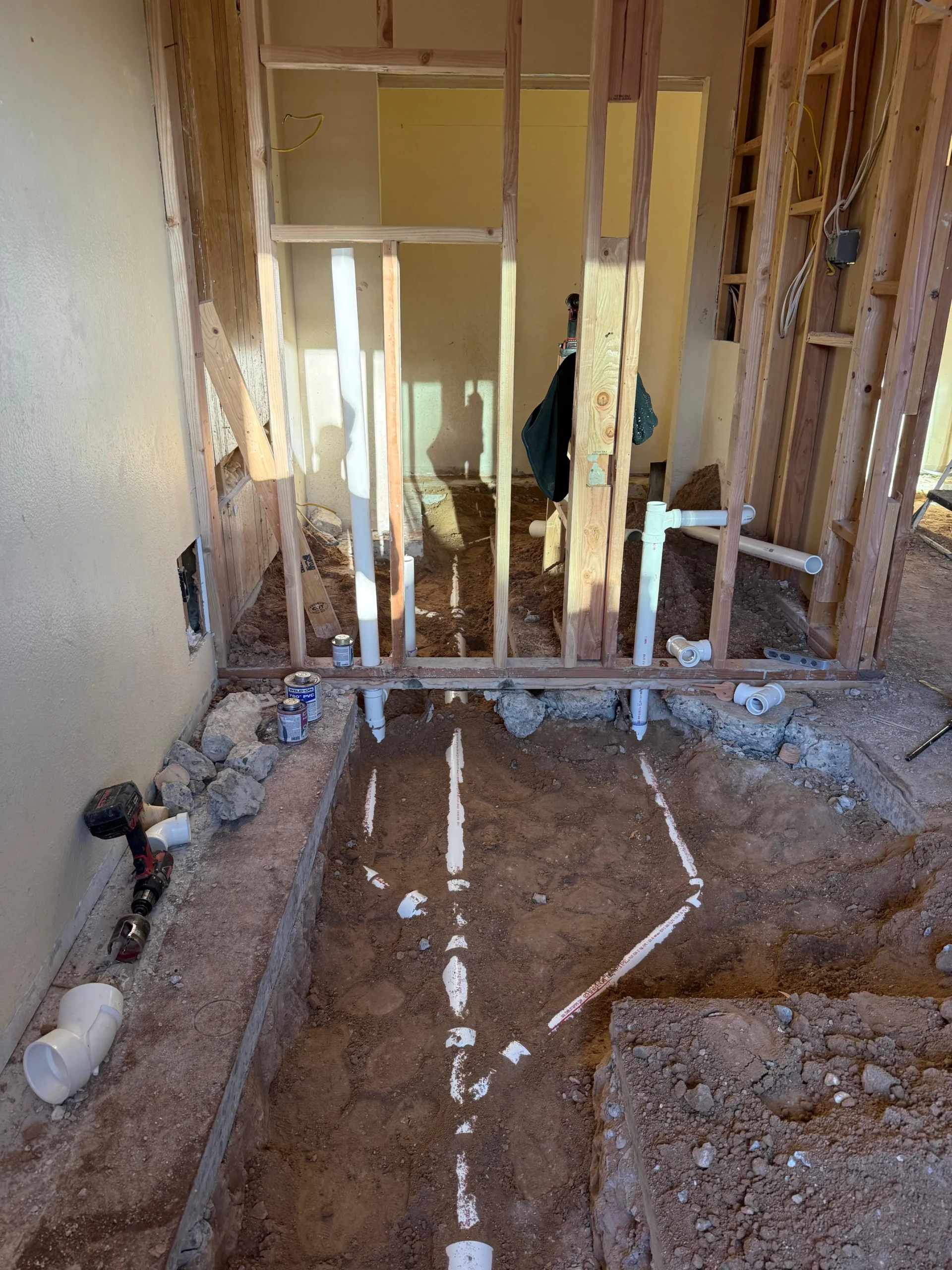
Every bathroom has three sets of pipes, and they do different jobs.
Supply lines bring hot and cold water to the sink, the toilet, and the tub or shower. They’re small and under pressure, and each fixture has a shutoff, either under the sink or behind the wall.
Drain lines carry water away. They’re bigger, they run downhill, and each fixture has a trap, the curved piece that holds a little water so sewer smell can’t come back up.
Vents are pipes that run up through the roof so the drains can flow without gurgling. You never see them, but they’re why a drain moves smoothly.
Tub and shower plumbing also has a valve inside the wall. It mixes hot and cold and sets your temperature. That valve is the part you can’t get to without opening the wall, and it’s usually the first thing worth replacing in a remodel.
Knowing where everything sits tells you what a change will cost. Swapping a fixture in the same spot is simple. Moving it means moving the pipes too.
What Actually Goes Wrong in Old Bathroom Plumbing?
A shower valve that’s worn out. Inside the valve is a cartridge that mixes the water. When it wears, the temperature swings, the water drips from the head, or the shower gets harder to turn off. Hard water speeds that up, because mineral scale builds up inside the cartridge.
A shower pan that’s let go. The pan is the waterproof layer under the tile floor of a shower. When it cracks or the liner fails, water gets under the floor. You may not see a problem until the subfloor is soft or the ceiling below is stained.
Drains clogged below where you can reach. Hair and soap catch in the trap and the pipe past it. If a tub or shower drains slow even after you clear it, the problem may sit deeper in the drain line.
Corroded supply pipes and stops. The shutoff valves under the sink, called angle stops, stick and drip as they age. In older homes the supply pipes behind the wall can rust from the inside.
A leaking tub waste and overflow. That’s the drain and the overflow opening on the tub. The gaskets wear, and the water drips behind the tub where you can’t see it.
Tub and shower plumbing that doesn’t match what you want. Sometimes the pipes aren’t broken. They’re just in the wrong spot for the bathroom you’re planning.

How We Plan a Bathroom Plumbing Job
We start by looking at what you have. We check the shutoffs, the valve, the drains, and the pipes we can see. If a wall is already open, or will be, we look at what’s inside before we quote.
Then we talk about what you want. A new shower in the same place is a different job from moving the toilet across the room. We lay out the options and give you a price for each, so you can see what moving a fixture costs compared with leaving it.
The work follows in order. We rough in the new plumbing, then pressure-test the supply lines and test the drains before anything gets covered up. After the tile, vanity, and walls go in, we come back for the fixtures, set them, and test them one more time.
Here’s a mistake we see a lot: people pick fixtures first, then find out the plumbing behind them doesn’t match. A shower valve, a vanity, and a tub all have specific sizes and rough-in dimensions. It’s much easier to choose with the plumbing in mind.
Here’s what surprises people: the biggest cost isn’t always the new fixture. It’s what’s behind the old one. Once the wall is open, a corroded valve or a bad drain can turn up, and it’s easier and cheaper to fix while everything’s exposed. We’d rather tell you that at the start than after the tile is up.
Refresh the Fixtures, or Move Things Around?
Here’s how we think about it.
If you’re happy with the layout, swapping fixtures in the same spots is the simplest and least expensive path. The pipes are already there, and a new faucet, toilet, or vanity connects to what’s in place.
If you want a different layout, like a bigger shower, a freestanding tub, or a vanity on a different wall, the plumbing has to move too. That means new supply lines, new drains, and sometimes a new vent. In a house on a concrete slab, moving a drain can mean cutting into the floor, which adds cost and mess.
Neither is better. We’ll tell you what each one involves and what it costs, and we won’t talk you into a bigger project than you want.

Older Home in Old Town, Barelas, Nob Hill, or the North Valley? The Wall Will Tell You What’s In There.
Many homes in Old Town, Barelas, Nob Hill, and the North Valley were built decades ago, and a bathroom remodel is often the first time anyone has seen what’s inside the walls in years. We’ve opened walls and found old steel supply pipe, corroded valves, and drains that were patched more than once. A house along Central Ave from the Route 66 days might have plumbing that’s been added to, piece by piece. Because of that, we plan older-home bathroom work with some room for surprises, and we tell you right away what we find so you can decide what to do.
Slab Home in the Northeast Heights or East Side? Moving a Drain Is the Big Question.
A lot of homes in the Northeast Heights and on the East Side, from Tramway on down, sit on concrete slabs. In a slab home the main drain for the bathroom often runs under the floor. That’s fine if you keep fixtures where they are. If you want to move the tub, the toilet, or the shower, the drain has to move too, and that means cutting the slab. It’s doable, but it’s a real job, so it’s worth deciding early whether the layout is worth the change.
Newer Home on the Westside or in Rio Rancho? Big Bathrooms, Big Tubs, Hard Water.
Many homes on the Westside and in Rio Rancho, out past Coors Blvd, have a large primary bath with a soaking or jetted tub and a separate shower. That’s a lot of plumbing in one room. In a newer home the pipes are usually in good shape, and the work is more about updating fixtures and fixing whatever’s tired, like a worn shower valve or a tub that no longer holds heat. Our water here is hard, so scale builds up in cartridges, showerheads, and faucet aerators. If your shower or faucet has gotten weak, scale is often the reason.

Redoing the Whole Bathroom? Here’s What Bathroom Renovator Covers.
Our Bathroom Renovator service is for a full remodel, where the plumbing is changing along with the room. We look at the existing plumbing, plan the new layout, and give you the price for each part. We rough in the supply lines, drains, and vents, test everything before it’s covered, and then set the fixtures once the room is finished. If you want to keep the layout and just update what’s in it, we’ll say so, and you can save money.
Old Whirlpool Tub Taking Up Half the Bathroom?
A jetted tub is a lot of machinery. There’s a pump, a set of jets, air controls, and usually an access panel somewhere so someone can reach the motor. When it breaks, parts can be hard to find, and the tub itself may be more than the room needs. Our Jacuzzi Remodel service covers fixing a jetted tub, or taking it out and putting in something that fits how you actually use the bathroom, like a regular soaking tub or a shower. Because a jetted tub runs on electricity, the electrical side has to be handled by a licensed electrician.
Shower Leaking, Dripping, or Needs Replacing?
Our Shower Installation & Repair service covers new showers and fixes for old ones. On the repair side that means worn valves and cartridges, dripping showerheads, a shower that won’t get hot, and leaks behind the wall. On the install side it means setting the valve, running the supply to the head, and connecting the drain, with the shower pan or base done right so water stays where it should. We find what’s wrong and show you before we recommend a fix.
Want to Trade the Tub for a Shower?
Plenty of people stop using the tub and want the room for a walk-in shower. Our Tub-to-Shower Conversion service handles that. We remove the tub, work out the drain, and set up the new shower valve, supply, and base or pan. A tub drain and a shower drain sit in slightly different spots, so the floor or slab may need some work. Many people choose this when they want an easier step in, and we can talk through what the new setup needs.
Sink Dripping, Clogged, or Leaking Underneath?
Our Sink Repair service covers the small stuff that drives you crazy. A dripping faucet is usually a worn cartridge or washer. A slow sink is often a clog in the trap or the pipe past it. A puddle under the cabinet can come from a worn supply line, a stuck angle stop, or a loose connection at the trap or pop-up drain. We fix it and tell you what caused it, so it doesn’t come back.
Tub Draining Slow, Leaking, or Needing New Plumbing?
Our Bathtub Plumbing service covers the plumbing in and around a tub. That includes slow or clogged drains, a leaking waste and overflow, a tub valve that’s worn out, and new plumbing for a replacement tub. If water is dripping behind the tub or into the ceiling below, we trace it first. We don’t pull a tub out on a guess.
Simple Things to Check Before You Call
- Look under the sink. Check for water on the cabinet floor, damp spots, or green crust on the connections.
- Test the shutoffs. Turn the valves under the sink and toilet. If one won’t turn or drips, it needs replacing.
- Clean the aerator. If a faucet’s flow is weak, unscrew the tip, rinse out the grit, and screw it back on.
- Check the shower for drips. If the head drips after you shut it off, the cartridge or valve is likely worn.
- Look at the ceiling below. A stain under a bathroom can point to a leak above.
Past that, this isn’t a DIY area. Don’t open a wall or pull a tub to look for a leak. You can damage the pan or the pipes and make a small problem bigger. Call us and we’ll find it first.
Remodeling and Need to Move Pipes or Replace the Old Ones?
If a remodel turns up old pipes that should be replaced, or you’re adding a bathroom, our New Construction & Repipe page covers rough-in plumbing and whole-home repiping. And if a bathroom leak has you worried about water under the floor, our Leak Detection & Slab Leaks page explains how we find a hidden leak.

Frequently Asked Questions
Bathroom Remodel Plumbing Costs in Albuquerque?
Expect about $6,500 on average for bathroom rough-in plumbing, with most jobs between $3,000 and $20,000, per Angi. Keeping fixtures in place costs much less than moving them. Call J&J Plumbing LLC at (505) 589-6934 for a free quote.
How much of a bathroom remodel is plumbing?
A lot of it. The valve, the drains, the vents, and the supply lines all sit behind the wall, and they decide what’s possible. We’ll walk you through the plumbing side so you know what each choice involves.
Can I move my shower or toilet to a different spot?
Usually yes, but the pipes have to move too. In a slab home, moving a drain can mean cutting the floor. We’ll give you the price for each option.
Should I replace the shower valve when I remodel?
If the wall is already open, it’s often a good time. A worn valve can leak or fail behind new tile, and it’s easier to replace before the wall is closed. We’ll tell you if yours still looks good.
Why is my shower temperature all over the place?
A worn cartridge or mineral scale inside the valve is a common cause. We’ll look and tell you if it needs a new cartridge or a new valve.
Can you convert my tub into a walk-in shower?
Yes, that’s what our tub-to-shower conversion is for. We’ll look at the drain and the floor and tell you what the job takes.
Do you handle the whole remodel or just the plumbing?
We’ll walk you through what we handle and where other trades come in, so you know who’s doing what before work starts.
Your Neighbors Already Trust the Fix
Trustindex verifies that the original source of the review is Google. Trustindex verifies that the original source of the review is Google. Trustindex verifies that the original source of the review is Google. Trustindex verifies that the original source of the review is Google. Trustindex verifies that the original source of the review is Google. Trustindex verifies that the original source of the review is Google. Trustindex verifies that the original source of the review is Google. Trustindex verifies that the original source of the review is Google. Trustindex verifies that the original source of the review is Google. Trustindex verifies that the original source of the review is Google. Get a Straight Plan and a Straight Price
Whether it’s one sink or the whole bathroom, we look at the plumbing first, tell you what we find, and give you the real price before any work starts.